A meaningful life
can't be outsourced.
The digital age gave us extraordinary tools. It also gave us more information, more choices, and more responsibility for making sense of our lives.
LifeOS gives your thinking, knowledge, work, and reflection a place to come together — so technology can strengthen your judgment without replacing it.
Living well is still your work.
Your life lives in too many places.
Your ideas are in notes.
Your work is in project tools.
Your reading is scattered across books, tabs, highlights, and saved links.
Your decisions disappear into conversations.
Your plans compete with notifications.
Your memories accumulate faster than you can make sense of them.
We gained extraordinary access to information.
We never built the architecture to live coherently inside it.
Technology should strengthen judgment.
Not replace it.
Modern technology increasingly promises to remove friction, make decisions, choose what deserves our attention, and think on our behalf.
Some of that is useful.
But a meaningful life still asks something of us.
- Attention.
- Judgment.
- Responsibility.
- Reflection.
- Choice.
LifeOS was built around a simple conviction:
The tools around us should help us become more capable of living our lives — not less involved in them.
“Living well is still your work.”
LifeOS doesn’t exist to automate you.
It exists to give your thinking and your commitments enough structure to remain your own.
Your thinking shouldn’t disappear when the tab closes.
LifeOS brings your knowledge, projects, reading, decisions, actions, and reflection into one connected environment.
Not another place to collect more information.
A place to make something of it.
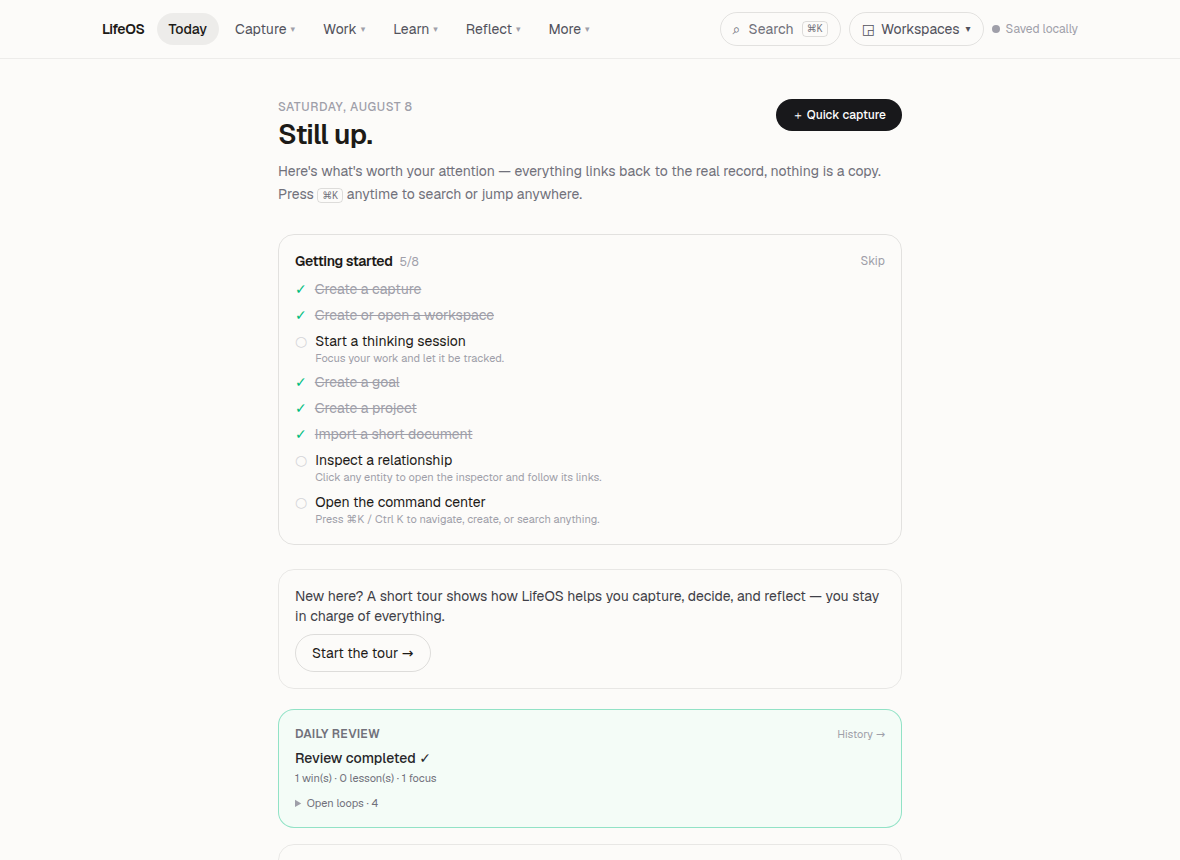
Capture
Make sense of what enters your life.
Organize
Connect knowledge, projects, decisions, and commitments.
Act
Turn intention into meaningful next actions and focused work.
Reflect
Review what happened and decide what deserves attention next.
Understand
See how your ideas, work, and life have developed over time.
A life is more than a collection of notes.
An idea can become a question.
A question can become research.
Research can change a belief.
A belief can shape a decision.
A decision can become a project.
A project becomes action.
Action becomes experience.
Experience becomes reflection.
LifeOS preserves those relationships instead of flattening everything into disconnected files.
- Idea
- Question
- Research
- Belief
- Decision
- Project
- Action
- Experience
- Reflection
And none of these have to live alone.
Not another system to maintain.
A place to return to.
Open Today. See what you chose to care about before the noise begins.
Capture something before it disappears.
An idea.
A question.
Something you read.
A decision you need to make.
Return to meaningful work.
Open a project.
Choose the next action.
Enter Focus.
Continue where you left off.
Reflect without scoring yourself.
What happened?
What changed?
What remains open?
What deserves tomorrow?
The point isn’t to spend your life managing LifeOS.
The point is to spend less of your life reconstructing what mattered.
The world is very good at telling you what to pay attention to.
LifeOS helps you remember what you decided matters.
Our attention is pulled in thousands of directions.
Information accumulates.
Convenience removes pauses.
Entertainment never ends.
Other people’s priorities arrive instantly.
LifeOS cannot decide who you should become.
It can give you a place to remember:
- what you believe,
- what you’ve learned,
- what you’ve committed to,
- what you’re building,
- and why you chose it.
Dignity isn’t something software gives you.
It is something a life aligned with your values can express.
Built for thoughtful work.
And thoughtful lives.
LifeOS isn’t organized around a profession.
It’s organized around a way of engaging with life.
Thinkers
For people who constantly collect questions, ideas, connections, and observations.
Students
For turning what you study into knowledge you can actually carry forward.
Writers
For preserving sources, questions, developing ideas, and the work surrounding the work.
Researchers
For connecting evidence, inquiry, notes, conclusions, and future questions.
Founders & Builders
For keeping ideas, decisions, projects, actions, and lessons in the same intellectual environment.
Lifelong Learners
For people who don't want what they read and discover to simply disappear.
Different lives.
The same need for coherence.
Built around ownership.
Not attention harvesting.
LifeOS can contain deeply personal material:
- ideas,
- questions,
- projects,
- reading,
- beliefs,
- decisions,
- reflection.
Software that holds those things should treat them with respect.
Your data
Your LifeOS records belong to you.
Exportable
LifeOS includes tools for taking your information with you.
Transparent
Sync, backup, recovery, and system status are visible rather than hidden.
No engagement games
No streak pressure, leaderboards, or manufactured urgency.
Human judgment
LifeOS supports decisions without pretending the software should make your life choices.
The digital age did not remove
the responsibility of living well.
It multiplied it.
- There is more to know.
- More to choose.
- More to remember.
- More competing for our attention.
We could respond by surrendering more of ourselves to the systems around us.
Or we can build better systems for ourselves.
LifeOS exists for the second path.
Not to live for you.
To help give your life architecture.
Build a life.
Don’t merely manage one.
Living well is still your work.
Give your thinking, knowledge, commitments, and reflection a place to belong.
No streaks.
No productivity scores.
No promise to think for you.
Just better architecture for the work of living.
Questions, answered honestly.
What LifeOS is, what it is not, and where it stands today. If a capability is not yet confirmed, we say so.